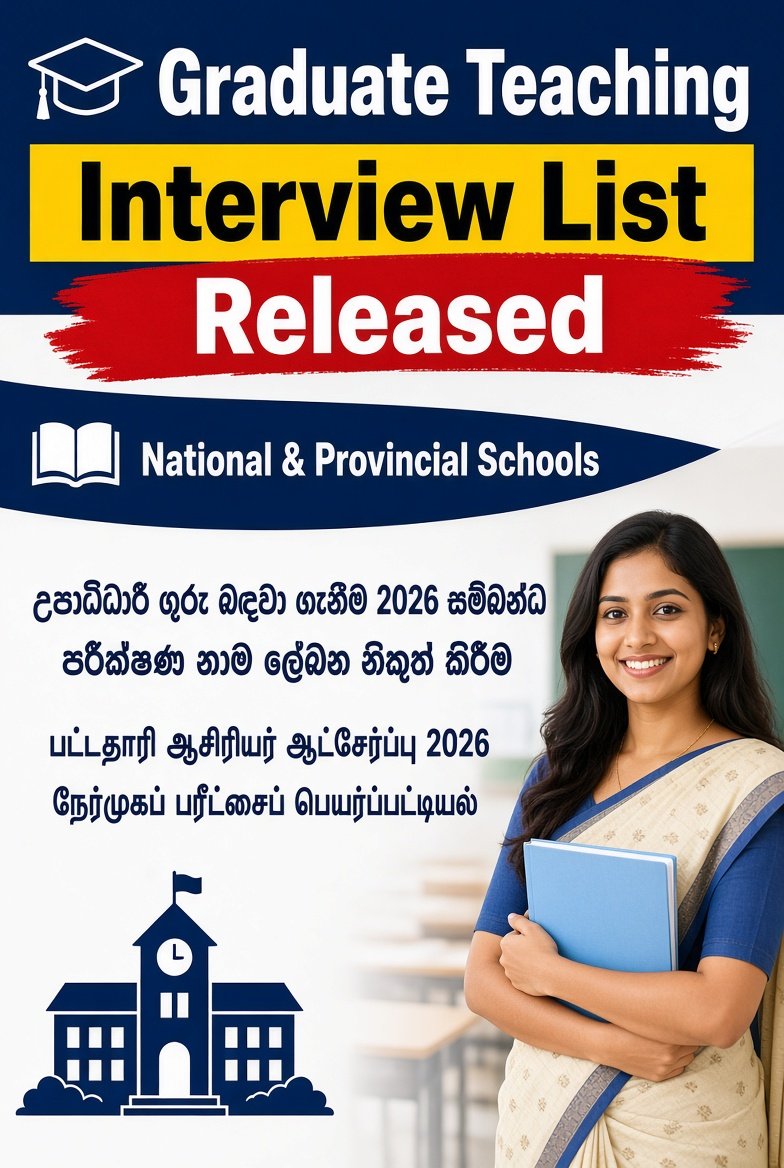
Graduate Teacher Recruitment 2026 – Full Provincial Interview Candidate Lists
The Ministry of Education, Sri Lanka, has provided province-wise links for the Graduate Teacher Recruitment Interview 2026. Candidates can visit the relevant provincial pages below to check the available interview candidate lists and related announcements.
Province-Wise Interview Candidate Lists
- Central Province – View Candidate List
- Eastern Province – View Candidate List
- North Central Province – View Candidate List
- Northern Province – View Candidate List
- North Western Province – View Candidate List
- Sabaragamuwa Province – View Candidate List
- Southern Province – View Candidate List
- Uva Province – View Candidate List
- Western Province – View Candidate List
Important Notice for Candidates
- Select your relevant province from the list above.
- Check the official Ministry of Education website for interview notices, candidate lists, dates, and further instructions.
- Read the official announcements carefully and follow the instructions provided by the relevant authorities.
- The lists and interview details may be updated. Please check the official website regularly for the latest information.
Official Website: Ministry of Education, Sri Lanka
SRI LANKA GRADUATE TEACHER RECRUITMENT 2026
The Ministry of Education, Higher Education and Vocational Education of Sri Lanka has announced the recruitment of graduates to the Sri Lanka Teachers’ Service in 2026 as part of the SRI LANKA GRADUATE TEACHER RECRUITMENT 2026 initiative to fill teacher vacancies in response to rising demand across the education system.
Vacancies cover Sinhala, Tamil and English mediums, and apply to both national and provincial schools, ensuring equal access nationwide. The program aims to attract graduates with diverse backgrounds who are prepared to teach core subjects and support student achievement across multiple regions.
The recruitment process is guided by Government Gazette notifications. In this system, a degree alone does not guarantee a teaching appointment. Applicants must meet prescribed educational and other eligibility requirements and complete selection stages for SRI LANKA GRADUATE TEACHER RECRUITMENT 2026.
According to the Gazette dated 2 February 2026, the recruitment process for graduates who are not currently employed in the public service includes a written competitive examination, a general interview and a practical test. Final selection depends on the applicable rules, available vacancies and the marks obtained at the relevant stages.
1. Who is conducting the recruitment?
The recruitment is conducted under the Ministry of Education, Higher Education and Vocational Education.
Additionally, the examination is administered by the Department of Examinations, with procedures for SRI LANKA GRADUATE TEACHER RECRUITMENT 2026.
The appointments are intended to fill specified vacancies in:
- National schools.
- Provincial schools.
- Sinhala-medium teaching posts.
- Tamil-medium teaching posts.
- English-medium teaching posts.
Recruitment is carried out only for the subjects and vacancies specified in the relevant Gazette.
2. What are the stages of selection?
For the open recruitment category covered by Gazette No. 2474/19, the selection process consists of the following main stages.
Stage 1: Written competitive examination
Eligible applicants must sit the written competitive examination conducted by the Commissioner General of Examinations.
Candidates must obtain at least 40 marks for each question paper to qualify for consideration for the general interview.
Meeting the minimum marks requirement does not automatically guarantee an interview. Candidates are considered according to their total examination marks and the number of vacancies available.
Stage 2: General interview
Candidates are shortlisted for the general interview according to their written examination merit order.
The Gazette states that up to twice the number of existing vacancies will be called for the general interview from candidates who meet the minimum marks requirement for each paper.
For example, if 100 vacancies are available in a particular recruitment category, the relevant authorities may call up to 200 eligible candidates for the general interview, subject to the Gazette’s selection rules.
During the interview, the authorities verify whether candidates meet the prescribed eligibility requirements. Applicants who do not fulfil the required qualifications may be rejected.
Candidates should therefore prepare their original certificates and supporting documents, including their degree certificates, academic transcripts and other documents required by the interview notice.
Stage 3: Practical test
Candidates who qualify at the general interview must face the practical test prescribed by the recruitment notification.
The marks obtained at this stage are forwarded to the Department of Examinations by the Ministry of Education or the relevant Provincial Public Service Commission.
The practical test is an important stage because recruitment is made according to the marks obtained in this test, subject to the applicable eligibility and vacancy rules.
Applicants should carefully read the instructions issued for their subject and prepare according to the relevant practical-test requirements. The exact assessment arrangements should be confirmed through official instructions rather than assumed to be identical for every subject.
Stage 4: Selection according to practical-test marks
According to the Gazette, recruitment is conducted on a school-based system.
Candidates are selected according to the priority order of marks obtained in the practical test, taking into account:
- The subject applied for.
- The language medium.
- The type of school.
- The number of available vacancies.
- The applicable school-placement and eligibility rules.
Therefore, candidates should not assume that passing the written examination or attending the interview means they will automatically receive an appointment.
Stage 5: School preference and placement
The relevant vacancy list is displayed to applicants at the time of the practical test. Candidates must indicate their preferences among the schools with vacancies.
However, obtaining a preferred school is not guaranteed. Placement depends on the applicable selection rules, marks and vacancies.
Where candidates seeking the same school receive equal marks, the relevant Ministry Secretary or Provincial Public Service Commission determines the placement in accordance with the Gazette.
3. Educational qualifications
Applicants must satisfy the educational requirements stated in the applicable Gazette and the Sri Lanka Teachers’ Service Minute.
For the open recruitment category in Gazette No. 2474/19, the main requirements include:
- A degree from a university recognised by the University Grants Commission or a recognised degree-awarding institution.
- Completion of the required subject content relevant to the teaching subject applied for.
- Compliance with the specific degree and subject requirements listed in the Gazette.
- Having passed Sinhala or Tamil as a subject at the G.C.E. Ordinary Level examination, or an examination recognised as equivalent under the notification.
The Gazette specifies that the degree qualifications and relevant conditions must have been fulfilled by 30 June 2025 for this recruitment category.
Why is the degree subject important?
Applicants cannot necessarily select any teaching subject simply because they hold a bachelor’s degree.
The authorities examine the main subject or subjects studied and the relevant credit content of the degree. In the applicable notification, at least one-third of the total subject content must relate to the subject applied for, subject to the specific qualification requirements for that subject.
Where the transcript does not show the relevant subject content or credit details, additional verification from the university may be required.
Candidates should consult the subject-qualification schedule in the Gazette before deciding which teaching post to apply for.
4. Which subjects are covered?
The Gazette includes a range of teaching subjects, depending on the prescribed qualifications and vacancies.
Examples include:
- Chemistry, Physics and Biology.
- Mathematics and related subjects.
- Engineering Technology and Information and Communication Technology.
- Accounting, Business Studies and Economics.
- Geography, History and Political Science.
- Sinhala, Tamil and English.
- Arabic and other foreign languages.
- Religious and civilisation-related subjects.
- Art, music, dancing and performing arts.
- Physical Education and Sport.
- Other subjects specified in the official vacancy schedule.
This is an indicative list, not confirmation that vacancies exist in every subject or language medium. The official Gazette’s subject and vacancy schedules must be checked before drawing conclusions about available posts.
5. National schools and provincial schools
Candidates can apply for national schools, provincial schools, or both, as permitted by the relevant notification.
For the open recruitment category, the Gazette sets out separate recruitment arrangements for national and provincial schools.
Applicants selecting provincial schools are considered according to the permanent-residence rules stated in the notification. For this particular Gazette, the province recorded in the 2025 electoral register is used to determine permanent residence.
Applicants may also indicate an additional province under the conditions specified in the Gazette. Consideration for that province depends on the absence of relevant vacancies in the applicable category and the availability of vacancies after eligible permanent residents have been considered.
There is also a specific restriction for applicants who are not permanent residents of the Eastern Province: the Gazette limits their applications for Eastern Province posts to subjects including Science, Mathematics, English, Information Technology, the Technology Stream and Counselling.
Candidates should read these provisions carefully before choosing their school category or province.
6. Can a selected teacher request a transfer?
The open recruitment Gazette provides that candidates recruited under this school-based system will not be granted transfers under any circumstances until they complete five years.
This is an important condition for applicants who hope to work near their home or in a particular district.
Before accepting an appointment, candidates should understand the school-based placement rules and consider whether they can serve at the assigned school for the required period.
7. Salary and service conditions
The Gazette specifies the applicable salary scale under the relevant government salary provisions.
For the open recruitment category covered by Gazette No. 2474/19, the stated scale is:
Rs. 53,060 – Rs. 66,600 per month, with the appointment placed at the specified salary step of Rs. 64,440 for the relevant Grade I(a) entry arrangement under Class 3 of the Sri Lanka Teachers’ Service.
Other government allowances may be payable in accordance with the applicable rules.
The Gazette also states that:
- The post is permanent and pensionable.
- Appointees are subject to a three-year probation period.
- The first Efficiency Bar Examination must be passed within the specified three-year period.
- Official-language proficiency requirements apply.
- Appointments are subject to the Sri Lanka Teachers’ Service Minute and other applicable public-service rules.
The figures and conditions above relate to the specific open recruitment notification. Applicants should check the applicable Gazette and subsequent official instructions before relying on them for an appointment.
8. What documents should candidates prepare?
Applicants should follow the exact checklist in their interview and practical-test notices. Depending on the applicable requirements, they may need:
- National Identity Card or other accepted identification.
- Printed application form.
- Degree certificate.
- Official academic transcript.
- Documents verifying subject content or credits, if required.
- G.C.E. Ordinary Level and other relevant examination certificates.
- Birth certificate or other personal records, if requested.
- Documents supporting eligibility under any special provision.
- Any other original or certified documents specified in the official notice.
For the open recruitment category, the Gazette instructs applicants to download the submitted application, have their signature attested by a Justice of the Peace and produce it at the interview.
Candidates should not rely solely on photocopies if originals are requested. The interview notice takes precedence regarding the documents to bring.
9. How can candidates check the results and interview lists?
Candidates should use the official websites of the relevant authorities to check announcements, interview lists, practical-test instructions and appointment information.
Official websites:
- Ministry of Education: https://moe.gov.lk/
- Department of Examinations: https://www.doenets.lk/
- Government documents and Gazette publications: https://documents.gov.lk/
The Ministry’s website is particularly important because the Gazette specifies that the list of candidates eligible for the general interview will be published there.
Candidates should check the official announcements regularly and verify their examination details carefully. They should not treat an unofficial social-media post or forwarded message as confirmation of selection.
10. Important points candidates must remember
- Passing the written examination does not guarantee an appointment.
- Candidates must obtain the prescribed minimum marks for each question paper.
- The general interview includes verification of eligibility.
- Candidates who qualify for the practical test are assessed according to the applicable arrangements.
- Final recruitment depends on practical-test merit, relevant vacancies and the official selection rules.
- School and province preferences do not guarantee placement at a preferred location.
- The five-year transfer restriction applies to the school-based recruitment covered by the open Gazette.
- Applicants must follow the instructions in the specific Gazette under which they applied.
- Candidates should check the Ministry of Education website for official interview and result announcements.
Frequently Asked Questions
1. Is a written examination required for graduate teacher recruitment in 2026?
Yes. For the open recruitment category covered by Gazette No. 2474/19, a written competitive examination is required.
2. What is the minimum mark required to qualify for the interview?
Candidates must obtain at least 40 marks for each question paper. The number called for the general interview is determined according to the merit order and the relevant vacancies.
3. Will everyone who passes the examination receive an interview?
No. Candidates must meet the minimum marks requirement and be within the number shortlisted according to the merit order and available vacancies.
4. Is the general interview the final selection stage?
No. Candidates who qualify at the general interview must also complete the prescribed practical test. Recruitment is based on the applicable selection rules and practical-test merit.
5. Can applicants choose their preferred school?
Candidates can indicate preferences from the vacancy list made available at the practical test. Final placement is subject to merit, vacancies and the applicable rules.
6. Can a newly appointed teacher transfer to another school immediately?
Under the open recruitment Gazette, transfers are not permitted until completion of five years under the specified school-based system.
7. Where can applicants check the interview list?
Candidates should check the official Ministry of Education website at https://moe.gov.lk/ and follow announcements relevant to their recruitment category.
8. Are the application dates still open?
The application period stated in Gazette No. 2474/19 was from 20 February 2026 at 9.00 a.m. until 5 March 2026 at 9.00 p.m. That application window has closed. Candidates should check the Ministry’s website for subsequent interview, examination-result or appointment announcements.
Conclusion
The 2026 recruitment of graduates to the Sri Lanka Teachers’ Service follows a structured selection process intended to fill specified teaching vacancies in national and provincial schools.
For the open recruitment category, the process includes a written competitive examination, a general interview and a practical test, followed by school-based selection according to practical-test merit and the applicable vacancy rules.
Graduates who applied should regularly check official announcements, prepare the required documents and carefully follow the instructions issued by the Ministry of Education and the relevant authorities. The applicable Gazette remains the primary reference for eligibility, selection and appointment conditions.
Official reference: Gazette Extraordinary No. 2474/19, dated 2 February 2026, Competitive Examination for the Recruitment of Graduates to the Sri Lanka Teachers’ Service for Sinhala, Tamil and English Medium Teacher Vacancies in National and Provincial Schools of the Island – 2026.